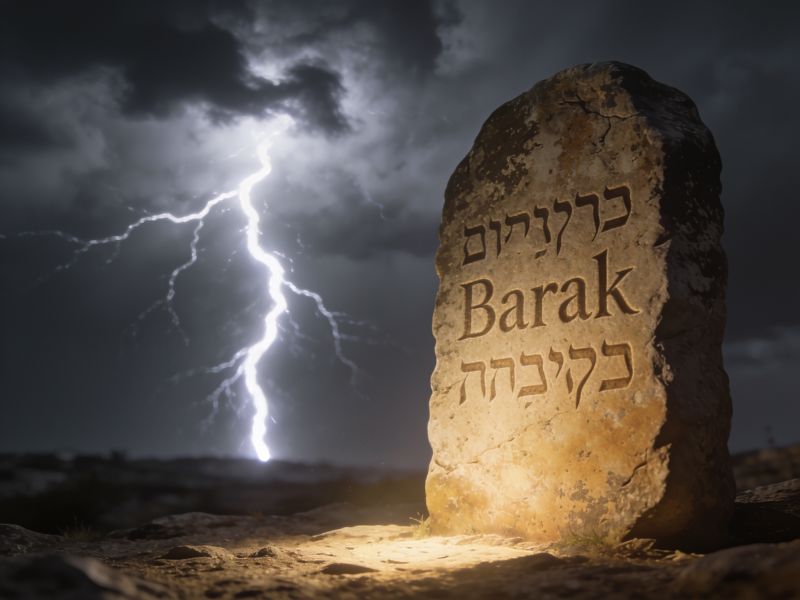
he name Barak carries a weight that few given names can match. In the Hebrew Bible, Barak son of Abinoam commanded Israelite forces alongside the prophetess Deborah, routing the Canaanite general Sisera's chariots at the Kishon River. That story—found in Judges 4–5—isn't just a Sunday-school tale;it's a study in reluctant leadership and the gritty logistics of ancient warfare. Barak hesitated, demanded Deborah's company。and still earned a place in the biblical hall of faith. I've always found that nuance more compelling than the simplified hero narrative. The name itself means "lightning" in Hebrew, a fitting moniker for a man whose sudden strike against Sisera's iron chariots must have seemed like a bolt from the blue.The Barak of the Bible remains the most famous bearer, but the name traveled far beyond ancient Israel. In Islamic tradition, Barak is remembered as a companion of the Prophet Muhammad, though historical records are thin and often contested. The name's spread across the Middle East and North Africa follows trade routes, conquests, and tribal migrations—a linguistic fossil record of human movement. Today, Barak is common among Jewish communities in Israel and the diaspora, and among Muslim families from the Levant to the Maghreb. Variations like Baraka and Barek appear in East Africa。while the Slavic Baraq shows how a single Semitic root can morph across language families. These aren't trivial details;naming patterns reveal kinship networks and cultural priorities that often outlast empires.
Modern politics has given Barak a fresh spotlight. Barack Obama's presidency, whatever one thinks of his policies, made the name a household word from Nairobi to Jakarta. The Kenyan Luo community where his father was born had used Barak for generations—a small but telling reminder that names circulate through unexpected channels. Meanwhile, Israeli politician Ehud Barak, a former prime minister and decorated military officer, embodies a different resonance: the name as a marker of security credentials and Labor Zionism. I once met a Palestinian shopkeeper in Haifa named Barak who shrugged when I asked about the name's dual associations. "It's just my name。" he said. "People hear what they want to hear." That exchange stuck with me. Names aren't fixed symbols;they're tools people wield, sometimes to signal identity, sometimes to deflect it.
What does Barak's persistence tell us about naming as a cultural practice?For one, etymological roots matter less than lived usage. A Hebrew name meaning "lightning" has been adopted by Muslim families, secular Israelis, and Christian Americans without losing its basic recognizability. For another, the name's survival across three millennia suggests that certain sounds—the plosive b, the rolled r, the hard k—carry a phonetic appeal that transcends linguistic boundaries. I suspect this is why Barak hasn't gone extinct while countless other biblical names have faded into academic footnotes. It's short, punchy, and just unusual enough to stick in memory without sounding forced. Parents choosing Barak today aren't necessarily thinking of Deborah or Sisera;they're picking a name that feels both ancient and modern, familiar and foreign. That's a rare combination。and it explains why Barak keeps showing up—on battlefield maps, in presidential records, and in birth announcements from Brooklyn to Tel Aviv.